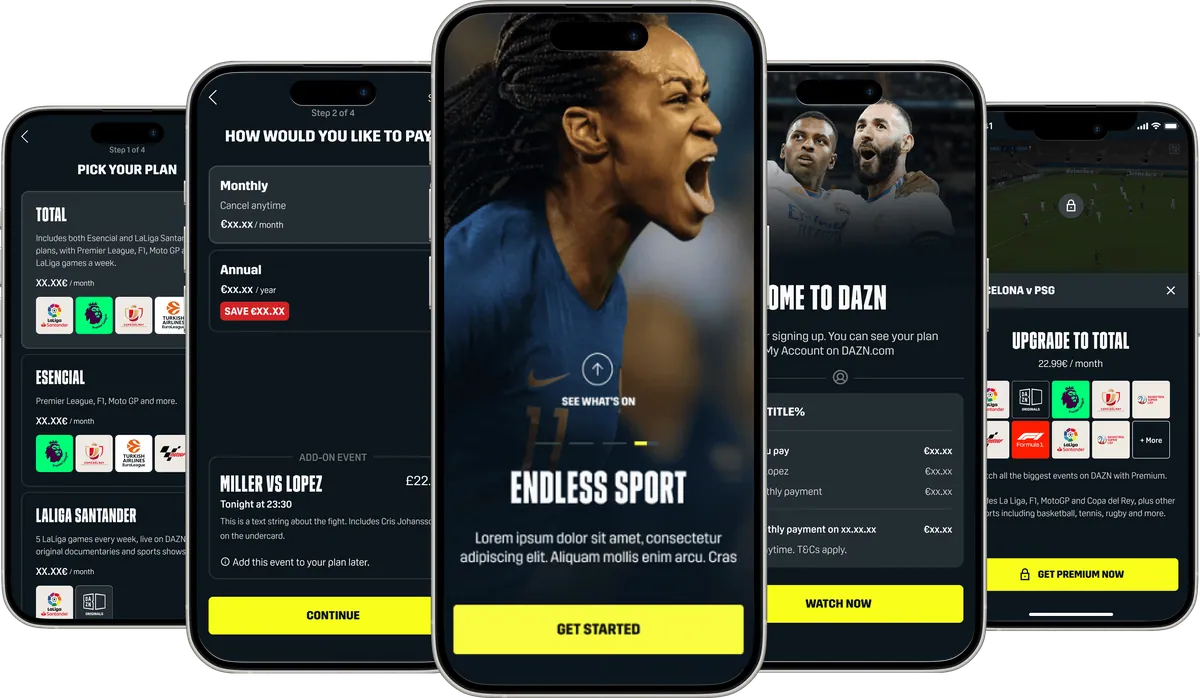
Launching DAZN's Subscriptions
← All workMoving DAZN from one flat subscription to a flexible, multi-tier model.
6 platforms. 5 markets. 14 new subscription packs.
The Challenge
- Price sensitivity: Price rises were already the main driver of churn at DAZN
- Piracy concerns: High-profile rights were a prime target for illegal streaming. Fans needed a credible low-cost option.
- Fragmented Audiences: Interests varied sharply by sport and market, which made packaging content complex.
- Monetisation: DAZN needed a smarter structure for its major rights (LaLiga, Serie A, J.League, NFL) to drive growth.
The Approach
The business case started with feature-based tiers (Mobile Only, 4K, Downloads), built to move users onto premium plans. We tested that assumption against a second model: content-based tiers that let fans pay for the sports they actually watch. The aim was to match real viewing behaviour and improve retention.
Role: Senior Product Designer, leading design end to end across a multidisciplinary team of 12.
Choice Architecture
To ground the work, we ran a choice architecture study into how fans make subscription decisions.
We compared feature-based with content-based tiering (e.g. football only, combat sports only), measuring price perception, willingness to pay and how easily users understood each structure.
Preferences varied by market. That insight shaped a model balancing flexibility, perceived value and commercial goals.
Framing the problem
I kicked off with How Might We sessions across the design & product team, mapping problems across the full DAZN journey: acquisition, engagement and retention. The output became the problem backlog that guided research and design throughout.
User Flows
With engineering and solution architects, we mapped a first-pass solution to agree technical constraints early. I then produced three core user flows across web, native apps and TV. The hard part was entitlements. Access varied by plan and device, so every flow had to know what a user could watch, where, and when to offer the upgrade & set limits.
Low fidelity wireframing
Wireframes turned the flows into testable concepts. We explored different ways to present sign-up, plans and payment, including monthly instalments versus paying upfront.
Stakeholder alignment
Workshops with stakeholders and PMs, including dot voting, gave us fast agreement on which concepts to take into usability testing.
Approach to usability testing
We began usability testing with the Acquisition flows, as they formed the foundation of the project and provided the most critical insights into how users interpreted the new plans, as well as their expectations around features and content. These findings went on to shape the account, discovery, and engagement aspects of the UX.
Given the complexity of the project, we took a sequenced approach to testing, ensuring each phase built upon previous insights. This prevented redundancy across domains and allowed us to streamline decision making, increasing confidence at each stage.
The majority of this research was conducted via usertesting.com, in the early stages it would be facilitated by our inhouse UXR team. Once we had a good understand on the foundations we would itteratively test areas via unmoderated testing.
Testing diverging concepts
We started with acquisition. It was the foundation of the project and gave the clearest read on how users interpreted the new plans and what they expected from features and content. Those findings then shaped account, discovery and engagement.
Testing in sequence meant each phase built on the last. It avoided duplicated effort across domains and raised confidence with every decision.
Most testing ran on UserTesting. Our in-house UXR team moderated the early rounds. Once the foundations were proven, we moved to rapid unmoderated tests.
Harmonising Components
With multiple squads designing in parallel, inconsistencies crept in. We ran a one-week harmonisation sprint to map discrepancies and realign designs. The output was a component guide defining symbols and usage rules, keeping the UX/UI consistent across every touchpoint.
Converging on a solution
After establishing an initial direction we moved at full force rapidly iterating and testing across all touch points of the experience.
Launch impact
The structure did both jobs it was designed for. The top tier converted strongly from launch week. The entry tier gave price-sensitive fans a legitimate way in, and many gradually traded up.
DAZN has since credited unbundling sports content and the roll out of tiered subscriptions with maximising revenue, reporting a 50%+ rise in underlying profitability in 2024, on revenue of over $3bn.